

Gainward Geforce Gtx 1050 Ti Test
Our Verdict
Contest is trigger-happy in the ultra-budget category, but the GTX 1050 Ti proves to be the best sub-$150 menu on the marketplace.
For
- Plays 1080p loftier well and is very affordable
- Quiet and efficient—no power connector required
- All 1050 Ti models have 4GB VRAM
Against
- Not really faster than terminal year'due south $200 cards
Nvidia is wrapping upwards their GTX 10-serial GPUs with the GTX 1050 Ti and GTX 1050, which will probable be the last GTX 10-serial GPUs until next year's GTX 1080 Ti (or whatsoever that ends up beingness called). I put both cards through their paces, and while you can read the GTX 1050 review (opens in new tab) elsewhere, for this piece, the focus is on the GTX 1050 Ti.
The GTX 1050 Ti and 1050 are based on a new GPU from Nvidia, the GP107. Unlike the GP100, GP102, GP104, and GP106 that have already seen calorie-free of day, the GP107 is manufactured on Samsung's 14nm FinFET procedure—all the other Pascal GPUs are currently using TSMC'due south 16nm FinFET process. I wouldn't get likewise caught upwards on the difference in procedure size, since TSMC and Samsung have their own ways of doing things. What'south interesting is that the GP107 chips for now at to the lowest degree are targeting lower clockspeeds than the previous Pascal chips, to the tune of effectually 200MHz off the base and boost clocks. Is that because of Samsung's 14nm process, or merely a case of Nvidia intentionally shooting a bit low to stay within the desired power target? It's tough to say for certain, just it might exist a bit of each.

I don't anticipate seeing anything lower on the Pascal spectrum in the firsthand hereafter—Nvidia seems content to have all the 10-series as GTX models for now, so at that place are no GeForce 1040/1030 or whatever cards. Maybe those will come with fourth dimension, or more than likely Nvidia is ready to get out the low-performance market to their existing 900-series parts, and let those fight it out with integrated graphics solutions that in many cases aren't able to do much more than lite gaming. I remember it's besides telling that where Nvidia had 5 GTX 900 cards (not counting Titan X), they already accept half-dozen x-series parts (again, non counting Titan Ten), with a 1080 Ti presumably launching in January. Basically, Nvidia added two more models at the low end, except instead of simply irresolute the amount of VRAM, they're also irresolute clockspeeds and core counts.
The new parts are conspicuously going to slot in below the GTX 1060 3GB, with an appropriately lower price tag, and in event they supersede the existing GTX 950 and 960 with lower ability parts that cost about thirty per centum less. What nigh operation, though? I'll get to that before long, only based purely on the specs, I wouldn't wait too much to change from the 960 and 950. Both 900-series parts have more CUDA cores than the 1050 replacements, and while the new cards are clocked college, that mostly makes them equal rather than significantly faster than their predecessors. Hither'southward an overview of the Nvidia sub-$200 budget landscape, with the old Maxwell and new Pascal parts.
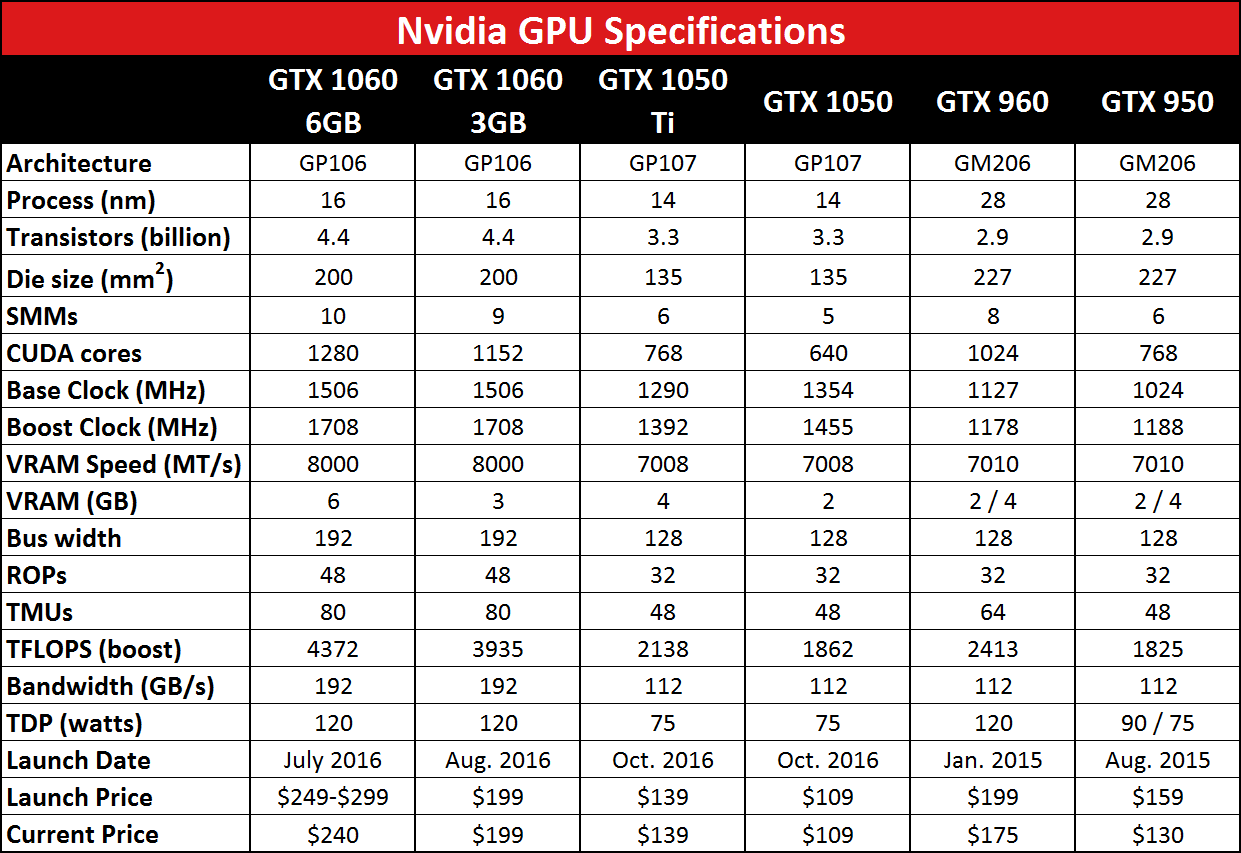
Newspaper specifications aren't everything, merely given the similarities between Pascal and Maxwell, the major advantages for the new 1050 parts are power requirements, dice size, and price. Die size is mostly an reward for the manufacturer—find that the GP107 is forty percent smaller than the GM206, for case. That means on a 300mm^two wafer Samsung could potentially get effectually 435 GP107 fries, whereas GM206 would get around 250 chips. Factor in a constant defect rate and yields for GP107 might be close to twice as loftier per wafer every bit GM206. The smaller size and potentially improved yields are passed forth to the consumer, though, which is a big part of why the new graphics cards are priced so attractively.
Where things get a little murky is when y'all factor in architectural improvements from Pascal. The biggest addition in a card similar the 1050 Ti is improved delta color compression, which Nvidia has previously claimed reduces retentivity bandwidth load by effectually xxx percentage. That ways while the 960 is in theory faster based on raw computational power, the 1050 Ti may take the lead in situations where improved retention bandwidth comes into play. Mayhap just as of import, however, is that the 1050 Ti costs $xl less than the 960 4GB, and it's launching at a price roughly $80 lower than the 960 4GB. I'm also happy that Nvidia isn't making a 2GB 1050 Ti, leaving that to the ultra-budget GTX 1050.
Ultra-Budget PC
We normally shoot for effectually $750 in our all-time budget PC (opens in new tab), only if you're willing to give upwards a bit of performance you lot can drop to the GTX 1050 Ti and go the price downwards to $600.
What's exciting is that, using the GTX 1050 Ti, you lot can build a legitimate upkeep gaming PC for under $500—see the in a higher place parts listing as 1 example. Or if you already have a PC but only demand a graphics card, for less than one-half the price of a gaming console y'all tin can go a reasonably capable GPU. Just don't expect a $140 GPU to compete directly with the $200 GTX 1060 3GB and you'll be fine. Merely that's something we practice demand to consider—how much more than performance can you lot get by moving up to a more capable GPU? To answer that question, let's hit the benchmarks.
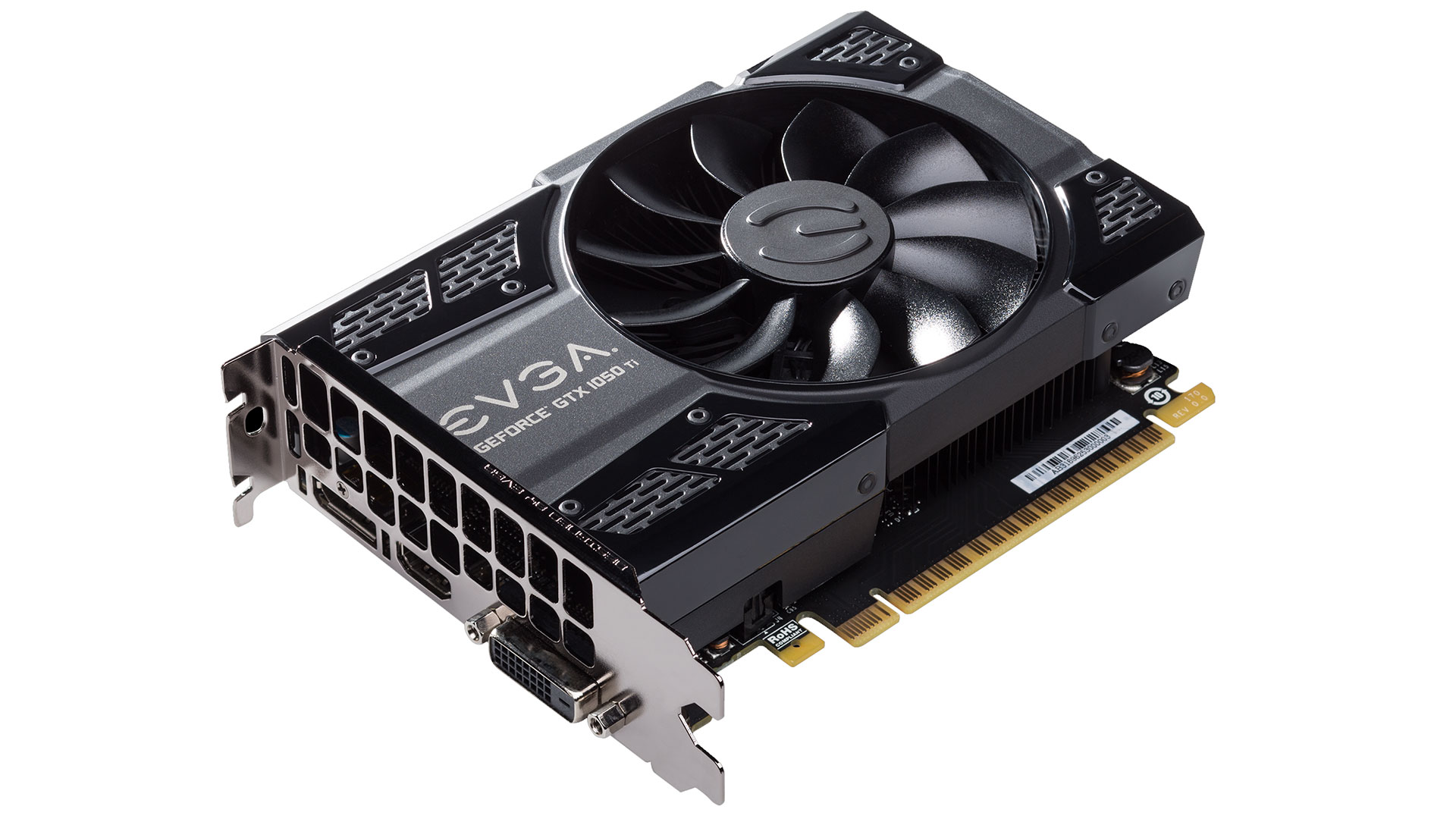
GTX 1050 Ti functioning
I've revamped our gaming exam suite to include a bunch of newer releases, and I've ditched some older games, making the benchmarks more relevant. All of the cards are tested on their 'best' API, which means unless there's a specific reason to prefer Vulkan or DX12 over OpenGL or DX11, most games run best with DX11/OpenGL on the 1050 Ti. Of the games tested, only Ashes of the Singularity, Hitman, and Gears of War 4 are tested in DX12 way on all cards—Gears of form beingness DX12-sectional, and the other ii considering they generally run better in DX12 mode.
Since the GTX 1050 Ti is a budget carte, I'thou limiting testing to 1080p at medium and ultra quality, with 1440p ultra results showing whether there's room for the card to reach higher in some games. I'm skipping 4K testing entirely, equally that's manifestly not the target of budget offerings. I'1000 using a decidedly non-budget test system, with an overclocked Core i7-5930K, only in nigh of the games that'southward non a major factor. I've spot-checked performance with a simulated i3-4360 (dual-core, 3.7GHz) and found most games are completely GPU limited with the GTX 1050 Ti and 1050. The primary competition for the 1050 Ti is a flake nebulous, every bit the RX 460 4GB costs $20 less while the RX 470 4GB costs $30 more than, leaving the 1050 Ti stuck in the center. I've included those cards, as well as some older GPUs and some cards that are a step upwardly for comparison.
Bike through the above images to see the private gaming benchmarks.
The GTX 1050 Ti stakes a claim to the fastest $140-ish budget GPU on the marketplace, hands beating the RX 460 4GB—though that card does cost a bit less. It's non even a close matchup, really—RX 460'southward all-time games in our suite are Hitman and Deus Ex, where the 1050 Ti is still around 10 percent faster in virtually cases, though the 460 does pull off a tie in DXMD at 1080p medium. Elsewhere, Nvidia'southward advantage tin can be huge, like the 40-fifty percent lead in Civ6, 35-40 percent in Fallout 4, and as much as 70 pct in GTA5 (not that either menu really handles 1080p ultra very well there). Even in commonly AMD-centric games like Ashes and Doom, the 1050 Ti holds a 25-xxx percent lead over the RX 460 4GB.
Looking at some older cards, things get a bit messier. Retrieve the GTX 960 4GB from last year? It delivers virtually identical performance to the GTX 1050 Ti—yep, while using more power, only otherwise they're the aforementioned level of performance. If you accept something similar a GTX 960 or R9 380, at that place's absolutely no reason to wait at the 1050 Ti, but what near budget gamers running something older, similar a 750 Ti? In that example, while I haven't collected numbers myself, AnandTech and other sites show the 950 outperforming the 750 Ti by around 35 percent on average, and by my numbers the 1050 Ti is effectually 20 percent faster than the 950. Together, that makes the GTX 1050 Ti about 60 percentage faster than the 750 Ti, a little more than than two and a half years afterward.
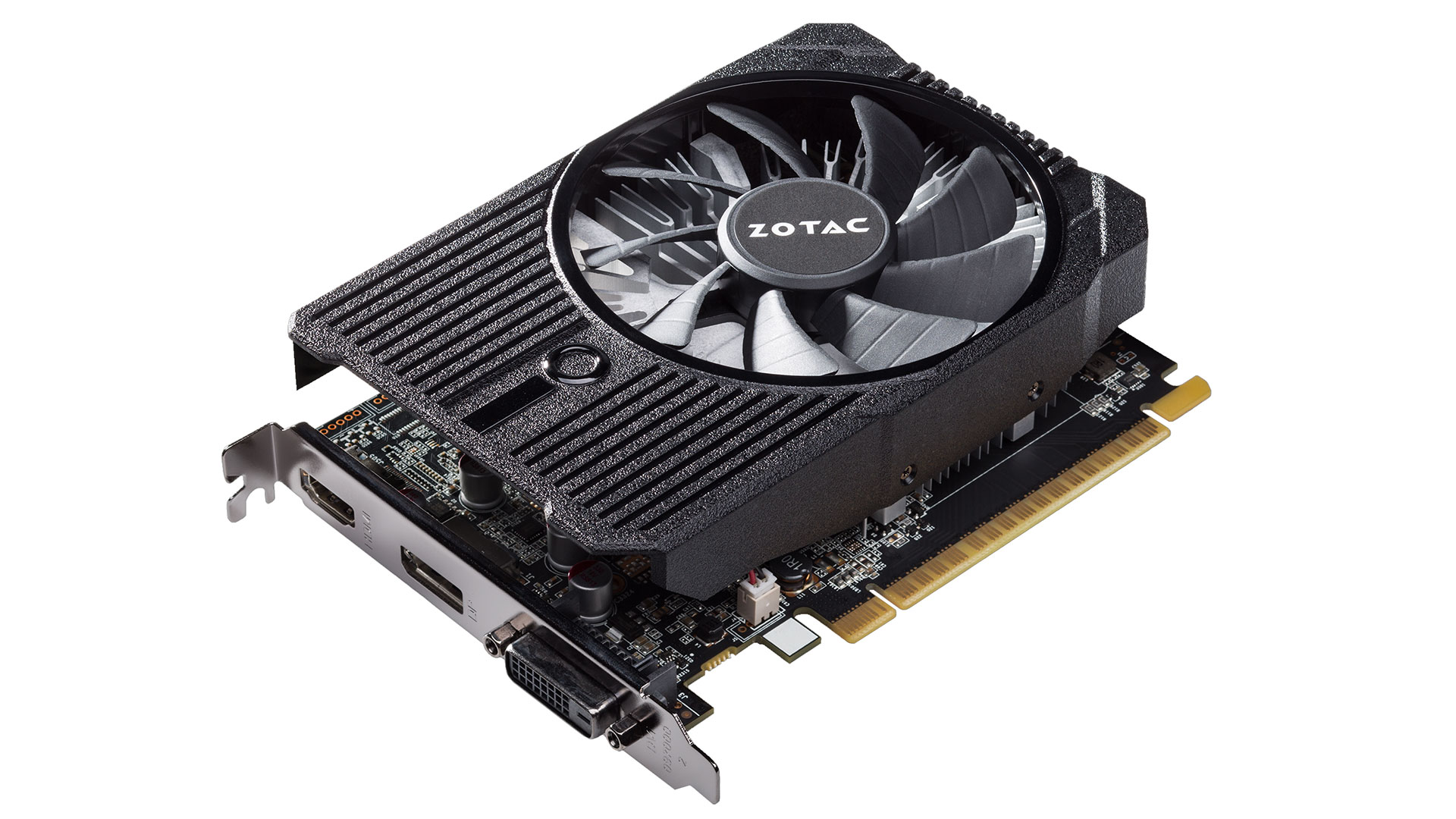
That's not actually giving the GP107 proper credit, though, because while information technology'south not faster it'due south more efficient and costs less. If you didn't upgrade to the 950 and 960 concluding year simply y'all were eyeing the level of functioning they provide—for esports or for less demanding gaming—the 1050 Ti is a great little carte du jour. What more, because nearly all the 1050 Ti models come sans power connector, you tin can use them in just most whatever PC made in the past v years. But there'due south still the matter of pricing.
The GTX 1050 Ti costs $140 (opens in new tab) or more, and the main competition is AMD's RX 460 4GB which can be found for as picayune equally $120 (opens in new tab). You pay more for more functioning, but which is actually the better value? The 1050 Ti is around 25 pct faster overall and costs 17 percent more than—maybe non a decisive victory, merely enough to requite it the win. The bigger problem for the 1050 Ti isn't the RX 460, but rather the RX 470 4GB (opens in new tab) and GTX 1060 3GB (opens in new tab), which are the side by side step upwards the pricing ladder. The AMD card is about forty percent faster and costs 29 pct more than, while the Nvidia card is 50 percent faster and costs 40 per centum more. If it makes sense to spend more than money for the GTX 1050 Ti over the RX 460, and so the 1060 3GB or RX 470 are equally sensible upgrades. Hither's what it looks like when I break things down to fps per dollar (or pound):
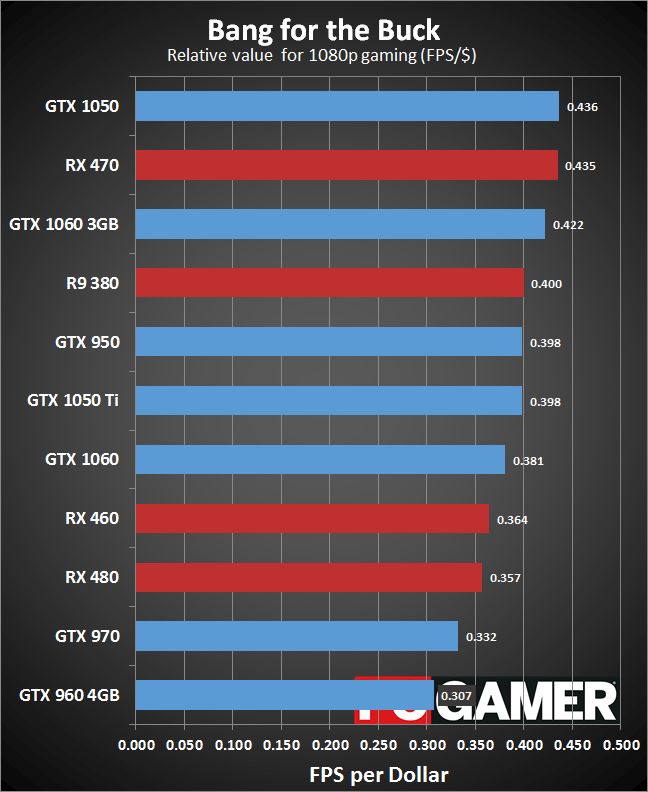
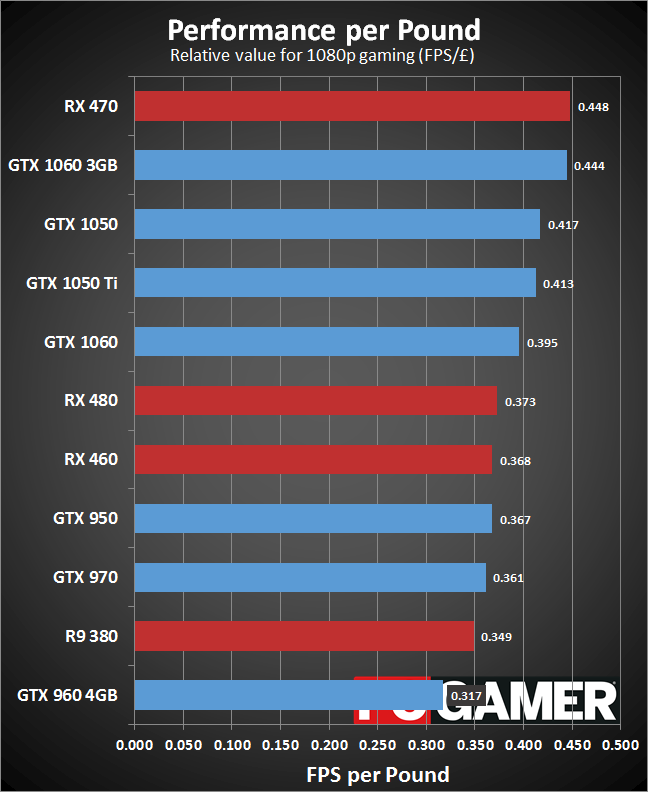
And there'south the real issue the GTX 1050 Ti faces. It reaches 60 fps at loftier or better quality at 1080p in most any currently available game. Just in terms of strict overall value, the RX 470 and GTX 1060 3GB are better bargains, and they'll provide a more enjoyable gaming experience every bit they're less likely to stutter during gaming sessions. The GTX 1050 also ranks above the 1050 Ti, which illustrates 1 of the issues with only looking at this 'relative value' chart, because in exercise I'd accept the 1050 Ti over the 1050.
Overclocking is possible, of form, and with EVGA Precision X 16 I was able to add another 150MHz to the core clocks, while the GDDR5 proved capable of +350MHz and more. Combined with increased power and thermal targets, along with higher fan speeds, that pushed the GTX 1050 Ti performance upward near 10 percentage. But y'all can exercise the aforementioned with other GPUs (except my RX 460, which seems to be a little temperamental), and without an external ability connector it seems the maximum clocks on the 1050 Ti may be a fleck limited. Personally, I observe GTX 1050 Ti is more than interesting as a near-silent gaming solution, and most of the cards come with modest factory overclocks.
If you lot take a difficult limit on pricing of $150 / £150, the GTX 1050 Ti arguably rates as the all-time graphics menu in the budget category. I'd place it above the GTX 1050, simply by virtue of the fact that I think 2GB VRAM on the 1050 will create some problems. I've seen problems with a few newer releases (Doom at ultra settings for instance), and with the next-gen consoles including more than memory, games are quickly moving beyond running comfortably in 2GB VRAM. If you tin spend merely a bit more money, the RX 470 4GB is the card I'd shoot for as a minimum level of performance for gaming.
Ultra-Budget PC
Our best budget PC (opens in new tab) usually costs $650-$750, just with the GTX 1050 you lot tin shave off another $90 from the price.
Ultra-Budget PC
Our all-time budget PC (opens in new tab) usually costs $650-$750, but with the GTX 1050 you can shave off another $90 from the price.
GeForce GTX 1050 Ti
Competition is vehement in the ultra-upkeep category, but the GTX 1050 Ti proves to exist the best sub-$150 card on the market place.

Gainward Geforce Gtx 1050 Ti Test,
Source: https://www.pcgamer.com/gtx-1050-ti-review/
Posted by: riveraprattaking.blogspot.com
0 Response to "Gainward Geforce Gtx 1050 Ti Test"
Post a Comment